
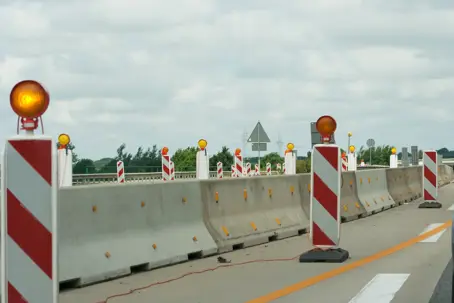
Texas highway work zones leave little room for error. Lanes narrow, traffic patterns change, concrete barriers reduce available space, and drivers may have only seconds to react to sudden slowdowns. Add an 18-wheeler weighing tens of thousands of pounds, and one mistake can result in catastrophic injuries.
But when a truck crash happens in a Texas highway work zone, determining who is liable is rarely as simple as blaming one driver.
The truck driver, the trucking company, the construction contractor, the traffic control company, or even a government entity may have played a role. Identifying every responsible party requires investigating what happened on the road and what was happening behind the scenes.
Why Texas Work Zone Truck Crashes Can Involve Multiple Parties
A highway work zone brings together several parties with different responsibilities.
Commercial truck drivers must operate safely in changing road and traffic conditions. Trucking companies are responsible for hiring, training, supervising, maintaining vehicles, and complying with federal trucking regulations.
At the same time, construction contractors may be responsible for creating and maintaining a safe work zone. Traffic control subcontractors may install signs, barrels, lane markings, and other devices. Government agencies may approve traffic control plans and oversee highway projects.
When any combination of those responsibilities breaks down, multiple parties may contribute to the same Texas work zone truck accident.
When the Truck Driver or Trucking Company May Be Liable
Truck drivers have a responsibility to adjust their driving to the conditions around them. That becomes particularly important in construction zones where lanes shift, traffic stops unexpectedly, and space is limited.
A truck driver may be negligent for speeding, following too closely, driving while distracted, failing to respond to warning signs, or operating while fatigued.
The trucking company may also bear responsibility.
A carrier can be held liable for a driver's negligence while acting within the scope of employment. Separate issues can arise when a trucking company hires an unsafe driver, provides inadequate training, fails to supervise a driver, ignores hours-of-service violations, or puts an unsafe truck on the road.
Those questions can turn a claim focused on one driver’s mistake into a much larger investigation of the trucking company’s safety practices.
Can a Construction Contractor Be Liable for a Work Zone Crash?
Sometimes the truck is only part of the problem.
A poorly designed or maintained construction zone can create dangerous conditions for everyone traveling through it. Confusing signs, abrupt lane changes, misplaced barriers, inadequate warnings, or poorly marked traffic patterns can increase the risk of a serious collision.
In those situations, the construction contractor or a traffic control subcontractor may share responsibility.
Determining whether the work zone contributed to the crash may require reviewing traffic control plans, project records, inspection reports, contracts, photographs, and video showing how the roadway was configured when the collision occurred.
This evidence can be especially important because work zones change quickly. A lane configuration that existed when a crash happened may look completely different days later.
Can TxDOT or Another Government Entity Be Responsible?
Government involvement can add another layer to a Texas highway work zone accident claim.
TxDOT, a city, a county, or another governmental entity may have responsibilities related to the roadway or construction project. Claims against government entities, however, are governed by special rules under the Texas Tort Claims Act.
These claims can also carry notice requirements that are much shorter than Texas’s general two-year personal injury statute of limitations. Depending on the government entity involved, notice may need to be provided within months of the crash.
That makes identifying potential government responsibility early particularly important.
Evidence Can Determine Who Is Responsible
When several companies are blaming one another, evidence becomes critical.
Truck telematics and electronic logging data may reveal speed, braking, driving hours, or possible fatigue. Dashcam footage can show how the collision unfolded. Traffic control plans and project records can establish how a construction zone was supposed to be configured compared with how it actually appeared.
Contracts can also help identify which company was responsible for specific parts of the project.
The goal is not simply to determine what the truck driver did seconds before impact. It is to understand every decision that contributed to putting the vehicles, roadway, and work zone in that position.
Building a Texas Work Zone Truck Accident Case
Serious Texas work zone truck crashes can involve powerful trucking companies, construction contractors, insurers, and government entities, each with its own explanation for why someone else should be responsible.
Hamilton Wingo has experience handling high-stakes, multi-defendant cases and uncovering the evidence behind catastrophic injuries. If you were seriously injured in a Texas work zone truck crash, Hamilton Wingo can help you understand which parties may be responsible and what your legal options may be.